

Recent Amendments and Proposed Changes to the Surrogacy Act: 2025–2026
Introduction:
If you are planning surrogacy in India, you have probably seen headlines about surrogacy Act amendments and wondered which ones are actually law. Between October 2025 and October 2026, one Supreme Court judgment, one set of government Rules and several review exercises changed the conversation. Some of these developments bind clinics and families today. Others are only proposals or pending court challenges.
This guide separates the two. It explains what changed under the Surrogacy (Regulation) Act, 2021 framework, what is still under review, and what intended parents and clinics should do now. It relies on the Gazette, the Supreme Court’s own judgment and the Department of Health Research portal wherever possible. Last checked: 26 October 2026.
Quick Summary: What Changed and What Is Still Pending
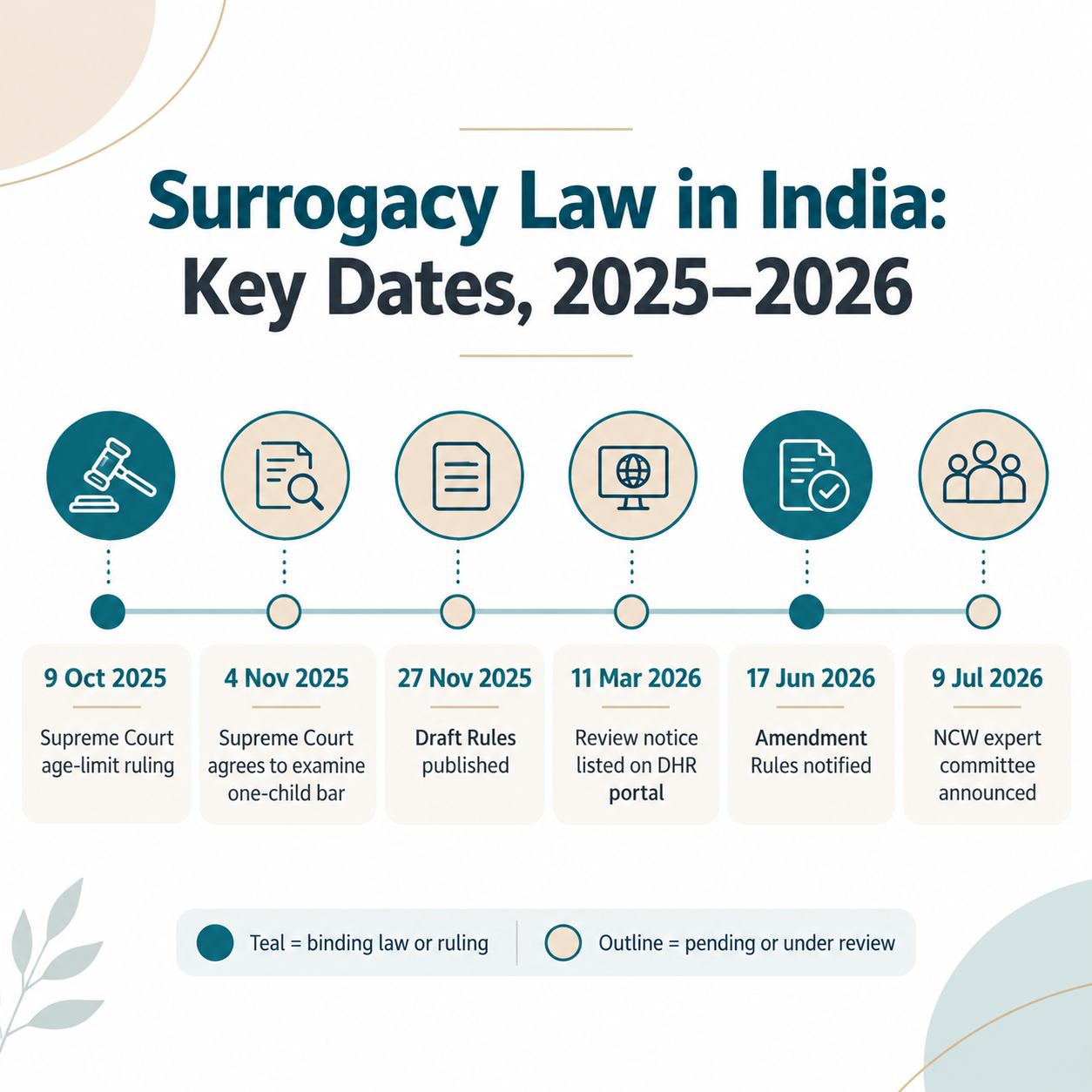
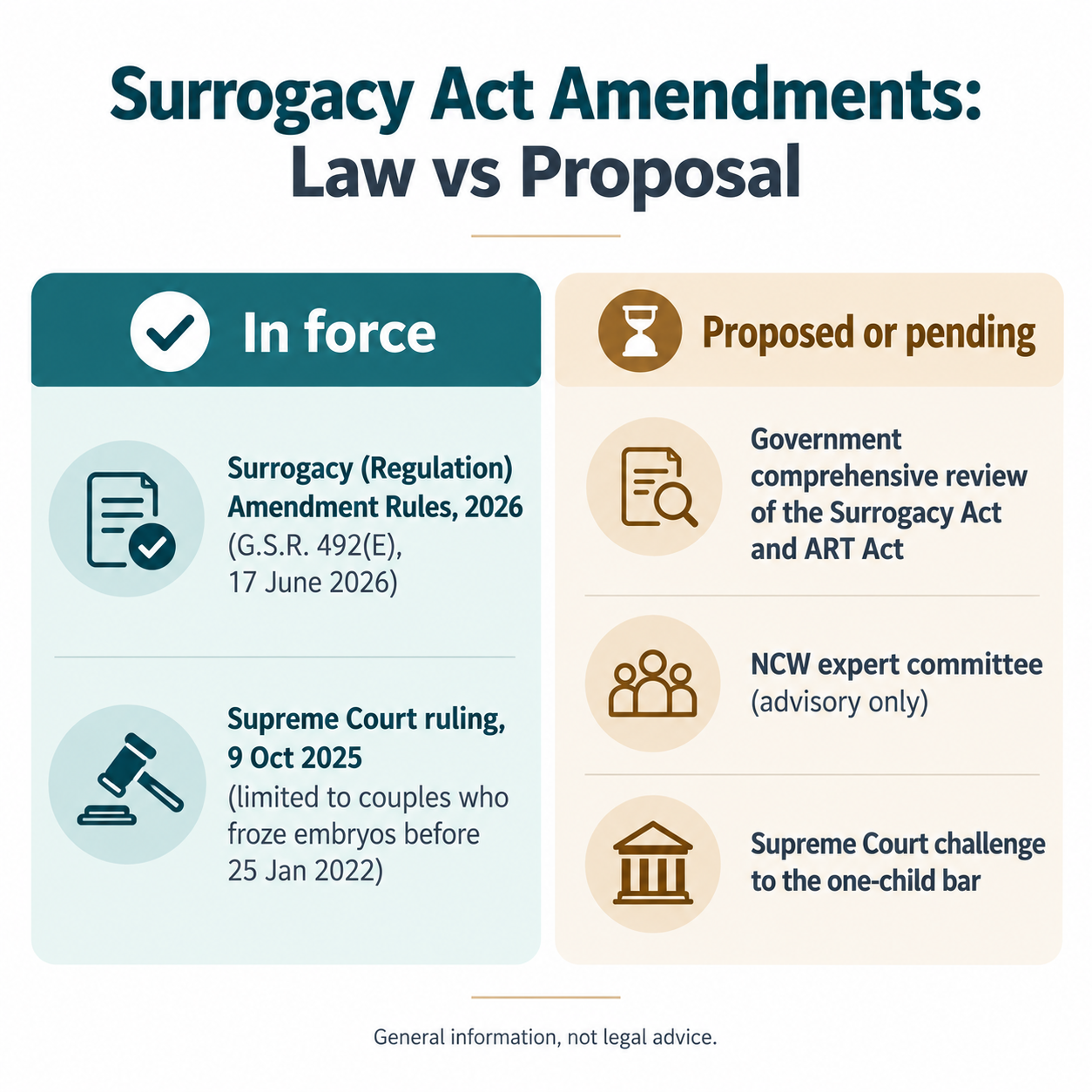
- In force: The Surrogacy (Regulation) Amendment Rules, 2026 (G.S.R. 492(E), 17 June 2026) added rules on clinic registration fees and renewal.
- Binding court ruling: On 9 October 2025, the Supreme Court held that the age limits in Section 4(iii)(c)(I) do not apply to couples who had frozen embryos for surrogacy before 25 January 2022.
- Under government review: The Department of Health Research lists a notice dated 11 March 2026 on a comprehensive review of the Surrogacy Act and the ART Act.
- Under expert review: The National Commission for Women formed an expert committee in July 2026 to examine how the two Acts and the 2026 Rules are working.
- Pending in court: The Supreme Court agreed in November 2025 to examine the bar on couples who already have a child.
How the Surrogacy Law Is Built: Act, Rules and Regulations
To judge any amendment, you first need to know which layer of law it touches.
- The Act. The Surrogacy (Regulation) Act, 2021 (Act 47 of 2021) came into force on 25 January 2022. Only Parliament can amend it.
- The Rules. The Surrogacy (Regulation) Rules, 2022 were notified on 21 June 2022 (G.S.R. 460(E)). The Central Government can amend them by notification, after publishing a draft for objections under Section 50 of the Act.
- Regulations and court rulings. The National Board can make regulations. Courts interpret the Act and sometimes limit how it applies.
According to the Gazette note in the 2026 amendment, the Rules were amended earlier by G.S.R. 772(E) (10 October 2022), 179(E) (14 March 2023), 415(E) (8 June 2023), 494(E) (11 July 2023) and 119(E) (21 February 2024). The 2026 Rules are the next link in that chain.
This matters because most “amendments” in the news are Rule changes or judicial interpretations. They are not changes passed by Parliament.
The February 2024 Donor Gamete Change: Essential Background
Any discussion of recent surrogacy Act amendments should start with the 2024 donor gamete change, because it still shapes eligibility. In March 2023, the Centre had notified a ban on donor gametes in surrogacy. After the Supreme Court allowed a woman with a rare congenital condition to proceed with a donor egg, and after similar petitions followed, the Centre amended the Rules. The amendment is dated 21 February 2024.
Under the amended Rules, surrogacy with a donor gamete is allowed if the District Medical Board certifies that the husband or wife has a medical condition requiring it. One condition remains. The child must have at least one gamete from the intending couple. Single women, meaning widows or divorcees, must use their own eggs and donor sperm.
This is background, not a 2025–2026 change. Still, it explains why a couple who cannot produce any gametes of their own remains outside the surrogacy route
Surrogacy Act Amendments in 2026: The Rules of 17 June 2026
The only formal amendment instrument we found for 2026 is the Surrogacy (Regulation) Amendment Rules, 2026. The Health Ministry notified them as G.S.R. 492(E) on 17 June 2026. A draft had been published on 27 November 2025 (G.S.R. 872(E)). The Rules took effect on publication in the Gazette.
The notification inserts two new rules into the 2022 Rules.
Rule 10A: Where Registration Fees Go
The registration fee for a surrogacy clinic must be deposited in a bank account in the name of the official designation of the appropriate authority. The authority must use it for activities connected with implementing the Act and the Rules.
Rule 11A: Renewal of Clinic Registration
- Form and timing. A clinic applies in Form 3 through the National Registry portal, at least 60 days before its certificate expires.
- Fee. The non-refundable renewal fee is ₹1 lakh. Government-run institutions pay nothing.
- Late applications. If the application is not received within that 60-day window, the clinic must pay ₹2 lakh, the same fee as initial registration.
- Hard copy. After the online application, a signed PDF printout must reach the State or Union Territory appropriate authority. The authority considers the application only from the date it receives both the fee and the PDF.
- Decision. The authority has 60 days to renew the certificate in Form 4 after inspection, or to reject the application with written reasons. It cannot reject without hearing the applicant.
- After rejection. The clinic may resubmit without paying again, if it complies with the law.
- Validity. A renewed certificate lasts three years from the date the earlier certificate expired.
What the 2026 Rules Do Not Do
They do not change who may commission surrogacy, who may act as a surrogate, the age limits, the donor gamete rules or parentage. Intended parents are affected only indirectly. The Act regulates surrogacy clinics and requires them to be registered, so it is sensible to ask your clinic for its current registration certificate and expiry date.
A companion notification, the Assisted Reproductive Technology (Regulation) Amendment Rules, 2026 (G.S.R. 491(E), same date), deals with renewal for ART clinics and banks. The national portal lists both. Read the notification itself for the ART fee details.
Supreme Court Ruling on Surrogacy Age Limits (October 2025)
The biggest legal development of the period came from the Supreme Court, not the government. In Vijaya Kumari S. and Another v. Union of India (2025 INSC 1209), decided on 9 October 2025, a bench of Justices B.V. Nagarathna and K.V. Viswanathan considered three couples who were above the statutory age limits.
The Rule Being Challenged
Section 4(iii)(c)(I) allows an eligibility certificate only if the intending couple is married and, on the day of certification, the woman is between 23 and 50 years old and the man between 26 and 55.
What the Court Decided
The couples had created and frozen embryos before the Act came into force on 25 January 2022. They said the COVID-19 pandemic stalled the transfer to a surrogate. The Court held that the age limit cannot be applied retrospectively to them. For this purpose, it said the surrogacy process “commences” once gametes are extracted and embryos are created and frozen for transfer to a surrogate.
According to the judgment, the age limit does not apply if the couple:
- began the surrogacy procedure before 25 January 2022;
- had completed gamete extraction and created and frozen embryos; and
- was on the threshold of transferring the embryos to the surrogate’s uterus.
The competent authority must then issue the certificate, provided the couple satisfies the medical indications in Rule 14 of the 2022 Rules. The petitioners were exempted from age certification, but only if they meet the Act’s other conditions.
What the Court Did Not Decide
The Court said it was not testing the validity of the age limits themselves. Couples who froze embryos on or after 25 January 2022 cannot rely on this ruling. It also told other similarly placed couples to approach their jurisdictional High Court rather than the Supreme Court directly.
This is a judicial interpretation of Section 4(iii)(c)(I), not an amendment. The text of the Act is unchanged. If you think you are covered, keep clinic records showing the date your embryos were created and frozen. Our guide on who owns frozen eggs and frozen sperm explains why those records matter.
Proposed Changes and Pending Challenges: What Is Still Open
Beyond the Rules and the judgment, several exercises could lead to further surrogacy Act amendments. To our knowledge, none has produced a binding change yet.
Government Review of Both Acts
The National ART and Surrogacy Portal, run by the Department of Health Research, lists a notice dated 11 March 2026 on a “comprehensive review” of the ART Act and the Surrogacy Act. We could not open the notice text. We therefore cannot say what the review covers, whether stakeholders may comment, or by when. Read the notice directly before relying on any summary.
NCW Expert Committee (July 2026)
On 9 July 2026, the National Commission for Women announced a committee led by former Delhi High Court judge Asha Menon. Its members come from the judiciary, medicine, forensic science, law enforcement, gynaecology, public policy and the Health Ministry. It will review how the ART Act, the Surrogacy Act and the 2026 Amendment Rules are working. NCW said it would propose standard operating procedures for ART clinics and examine safeguards on consent, privacy and biological traceability. Reports link the move to concerns about irregularities in the fertility sector.
This committee advises. It cannot change the law. A resulting amendment to the Rules would need government action, and a change to the Act itself would need Parliament.
Supreme Court: Couples Who Already Have a Child
Section 4(iii)(c)(II) requires that the intending couple have no surviving child, whether biological, adopted or born through surrogacy. An exception covers a child who is mentally or physically challenged, or who has a life-threatening disorder or fatal illness with no permanent cure, certified by a District Medical Board.
On 4 November 2025, a bench of Justices B.V. Nagarathna and R. Mahadevan agreed to examine whether this bar is unconstitutional for married couples with secondary infertility. The Union argued that surrogacy is a statutory privilege, not a fundamental right. Reports say Justice Nagarathna observed orally that the restriction appeared reasonable. We could not verify the outcome as of 26 October 2026. As far as we can tell, the provision continues to apply.
Other Reported Challenges
Challenges to the exclusion of single unmarried women have been before the Supreme Court and the Delhi High Court in earlier years. We could not verify any 2026 ruling that changes these exclusions. Treat them as unchanged.
Is There an Amendment Bill?
We did not find a Bill to amend the Surrogacy (Regulation) Act, 2021 in either House of Parliament. Check Parliament’s website and PRS Legislative Research before relying on this.
What Has Not Changed: Core Eligibility Under the Act
Despite the news, these core rules remain as set out in Section 4 of the Act, as quoted by the Supreme Court in October 2025:
- Altruistic only. Surrogacy is permitted only for altruistic purposes. The Act prohibits commercial surrogacy and attaches penalties to it.
- Medical indication. The couple needs a certificate of essentiality, which includes a District Medical Board certificate of medical indication for gestational surrogacy.
- Court order. A Magistrate of the first class or above must pass an order on parentage and custody, which serves as the birth affidavit.
- Insurance. The surrogate must have insurance coverage for 36 months, covering postpartum complications.
- The surrogate. She must be an ever-married woman with a child of her own, aged 25 to 35 on the day of implantation. She may act as a surrogate only once and cannot provide her own gametes.
- The couple. They must be married, with the woman aged 23 to 50 and the man 26 to 55 at certification, and without a surviving child, subject to the exception above.
- Single women. The Act allows only widows and divorcees, aged 35 to 45, to act as an “intending woman.”
Our guide to the legal requirements for surrogacy in India walks through each step.
What the Surrogacy Act Amendments Mean for Intended Parents
- Check your dates. If you froze embryos before 25 January 2022 and are over the age limit, the October 2025 ruling may help. Get legal advice on proof and on the High Court route.
- Confirm clinic status. Ask for the clinic’s current registration and renewal date.
- Do not treat proposals as law. News about the NCW committee or the government review is not a change in the Rules.
- Keep your paperwork. Certificates, Medical Board records, the court order and insurance papers all matter.
- Re-check before each step. The Rules have been amended six times since June 2022.
For a broader overview, see our complete guide to surrogacy law in India.
What the Changes Mean for Fertility Clinics and IVF Centres
- Renewal calendar. Rule 11A makes the 60-day deadline critical. A late application doubles the fee.
- Paperwork. Plan for both the online application and the signed PDF submitted to the State authority.
- Hearing rights. An authority must give you a hearing before rejecting a renewal.
- Dual registrations. Clinics holding registrations under both the Surrogacy Act and the ART Act should track each deadline separately.
- Compliance culture. The NCW committee’s focus on consent and traceability suggests closer scrutiny of records.
Our explainer on the ART Act for IVF clinics in India covers the related duties.
How to Track the Next Surrogacy Act Amendments
- National ART & Surrogacy Portal. The Department of Health Research posts Rules, Acts and notices here.
- Gazette of India. Draft Rules are published for objections for 30 days before they are finalised, as the 2026 notification shows.
- Supreme Court and High Court websites. Judgments in pending matters appear here.
- India Code. Use it for the Act’s text.
- Our blog. We update our surrogacy law guides when verified changes occur.
Frequently Asked Questions (FAQs)
Has Parliament amended the Surrogacy (Regulation) Act, 2021 in 2025 or 2026?
We did not find an amending Act or Bill. The changes we verified came through Rules and a Supreme Court judgment. Check Parliament’s website for updates.
What did the Surrogacy (Regulation) Amendment Rules, 2026 change?
They added Rule 10A on how registration fees are deposited and used, and Rule 11A on renewing a surrogacy clinic’s registration. Renewal costs ₹1 lakh, applications are due 60 days before expiry, and late applications cost ₹2 lakh.
Did the Supreme Court remove the surrogacy age limit?
No. On 9 October 2025, the Court held that the limits do not apply to couples who froze embryos before 25 January 2022 and were ready for transfer. It did not decide whether the limits themselves are valid.
Are donor eggs or sperm allowed in surrogacy in India now?
Since the February 2024 amendment, donor gametes are allowed where a District Medical Board certifies a medical condition requiring them. The child must still have at least one gamete from the intending couple. Confirm the current Rule text with a lawyer before you proceed.
Can a couple with one child opt for surrogacy in India?
Generally not. Section 4(iii)(c)(II) bars couples with a surviving child, except in limited medical situations. The Supreme Court agreed in November 2025 to examine a challenge. We could not verify an outcome.
Conclusion: What the 2025–2026 Surrogacy Act Amendments Really Amount To
So what do the surrogacy Act amendments of 2025–2026 amount to? Two binding developments stand out. The June 2026 Amendment Rules are administrative and affect clinic registration and renewal. The Supreme Court’s October 2025 ruling protects a narrow group of couples from the age limit. The comprehensive review, the NCW committee and the challenge to the one-child bar are proposed or pending, not law.
If you are affected by any of these changes, speak to a lawyer who practises in surrogacy law before you act. M&D Surrogacy Law Firm advises intended parents, clinics and NRI families on surrogacy law and ART compliance. You can book a consultation to discuss your situation. This article is general information, not legal advice, and no outcome is guaranteed.
Get Expert Legal Help Today
Need legal guidance regarding frozen embryos, IVF consent agreements, surrogacy, fertility law, or reproductive rights?
Contact M&D Surrogacy Law Firm, Chennai, for a confidential consultation.
Our Chennai-based team specialises in Surrogacy Law, IVF & Fertility Law, ART Act Compliance, and Reproductive Rights Legal Consultation.