
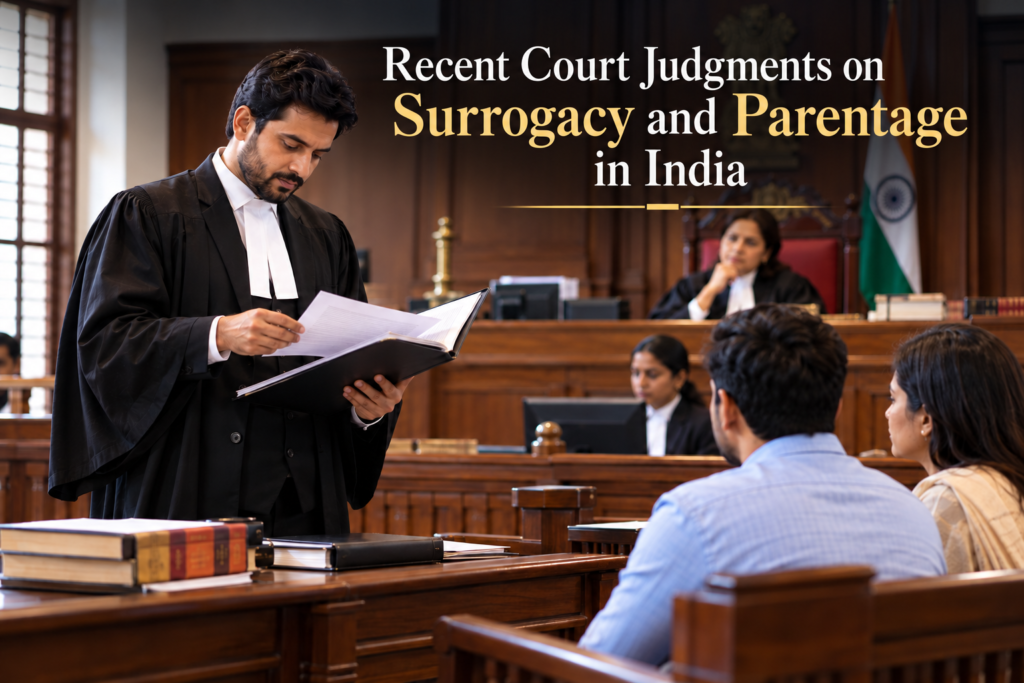
Recent Court Judgments on Surrogacy and Parentage in India
Introduction:
Surrogacy and parentage in India are shaped as much by courts as by statute. The Surrogacy (Regulation) Act, 2021 sets the rules, but since it came into force, the Supreme Court and several High Courts have been asked to decide what those rules mean in real families’ lives: who is old enough, whose embryos were created in time, and what a Magistrate may and may not examine before declaring legal parents.
This article explains the legal framework and walks through the most important recent rulings, current to 26 October 2026. It is written for intending parents and anyone trying to understand how Indian courts treat surrogacy and parentage. Some of these decisions conflict with each other, so we point out where the law is settled and where it is not.
How Surrogacy and Parentage Are Regulated in India
The Surrogacy (Regulation) Act, 2021 received assent on 25 December 2021 and came into force on 25 January 2022. It permits only altruistic surrogacy and prohibits commercial surrogacy. It operates alongside the Surrogacy (Regulation) Rules, 2022, which have been amended since, including in February 2024.
For most intending couples, three official steps matter:
- A medical indication certificate from a District Medical Board, confirming that gestational surrogacy is medically necessary.
- A parentage and custody order from a Magistrate of the first class or above (Section 4(iii)(a)(II)). After the child is born, this order serves as the birth affidavit.
- An eligibility certificate from the appropriate authority (Section 4(iii)(c)). For couples, this requires marriage and an age between 23 and 50 years for the woman and 26 and 55 years for the man, assessed on the day of certification. The couple must also not have a surviving child, subject to limited exceptions in the Act.
Single women are covered only if they are widowed or divorced and aged 35 to 45. A woman who is carrying a pregnancy for someone else must be a willing surrogate who meets the Act’s own eligibility conditions.
Why Court Judgments Matter
A Supreme Court decision binds every court in India. A High Court decision binds courts within its own state and is only persuasive elsewhere. Reports of “landmark” rulings often blur this line, so the discussion below says which court decided each case and how far its reasoning reaches.


Key Judgments on Surrogacy and Parentage in India
1. Supreme Court: Age limits and embryos frozen before the Act
Case and citation: Arun Muthuvel v. Union of India and connected cases, W.P.(C) No. 756/2022; 2025 INSC 1209; 2025 LiveLaw (SC) 990.
Court and date: Supreme Court of India (Justices B.V. Nagarathna and K.V. Viswanathan), 9 October 2025.
Background: Three couples had begun surrogacy before the Act commenced on 25 January 2022, by creating and freezing embryos when no age limit existed. By the time they sought to proceed, they were over the statutory age limit.
Legal question: Does the age limit in Section 4(iii)(c)(I) apply retrospectively to couples who had already started the process?
Decision and reasoning: No. The Court held that, for this purpose, surrogacy “commences” once gametes are extracted and the embryo is frozen with the intention of transfer to a surrogate, because the couple has then done everything it needs to do. The Court also reasoned that the State should not question the parenting ability of couples who started when no age limit applied, especially as there is no age limit on natural conception. It expressly did not decide whether the age limits are themselves valid.
Practical implications: This is binding nationwide, but narrow. It helps couples who froze embryos before 25 January 2022. The Court said similarly placed couples may approach their High Court. The broader challenge to the Act, including the ban on commercial surrogacy and the exclusion of unmarried single women, was not decided in this ruling.
2. Delhi and Allahabad High Courts: applying the Supreme Court's approach
Case and citation: Tapas Kumar Mallick & Anr. v. Union of India, W.P.(C) 3953/2025 (Delhi High Court, 27 October 2025); Anshu Shukla & Anr. v. Union of India, 2026:AHC-LKO:43965-DB; 2026 LiveLaw (AB) 406 (Allahabad High Court, Lucknow Bench, Justices Shekhar B. Saraf and Abdhesh Kumar Chaudhary, judgment reported as delivered on 7 July 2026).
Background: In Tapas Kumar Mallick, embryos were created and frozen in January 2021. In Anshu Shukla, embryos were preserved in 2015 and the wife was just over 50 when the couple sought to proceed.
Decision and reasoning: Both courts followed the Supreme Court. The Delhi High Court allowed the couple to proceed despite the wife’s age. The Allahabad High Court held that rigidly applying the age limit to such couples infringes reproductive autonomy under Article 21 and permitted them to apply to the Chief Medical Officer, Lucknow.
Practical implications: These show how the Supreme Court’s reasoning is being applied to individual cases. Couples with pre-2022 frozen embryos should keep clinic records proving the dates of extraction and freezing.
3. Kerala High Court (Division Bench): how a woman's age is counted
Case and citation: Rajitha P.V. v. Union of India, Writ Appeal No. 412/2025; 2025:KER:21383.
Court and date: Kerala High Court, Division Bench led by Chief Justice Nitin Jamdar, 13 March 2025.
Background: A Single Judge (13 February 2025) had held the wife ineligible because she had attained 50. The couple appealed.
Legal question: Does “between 23 to 50 years” end on the day a woman turns 50, or does it extend through her 50th year?
Decision and reasoning: The Division Bench set aside the Single Judge’s ruling and held that eligibility extends throughout the 50th year and ends on the day she turns 51. It reasoned that the upper limit permanently removes a woman’s right, unlike the lower limit. It directed the authorities to issue the certificate within one week.
Practical implications: This is binding in Kerala and has influenced courts elsewhere (see below), but not every court accepts it.
4. Delhi High Court: a different view on age
Case and citation: XX v. Union of India, W.P.(C) 19380/2025 (Justice Purushaindra Kumar Kaurav), 13 March 2026.
Background: The intending woman, born on 15 September 1975, was 49 when the medical indication certificate was issued on 30 June 2025. A clinic declined to proceed after she crossed 50 in September 2025. The court applied the rule that she attained 50 on 14 September 2025, the day before her birthday anniversary.
Decision and reasoning: The court respectfully disagreed with the Kerala Division Bench. Applying the legal rule that a person attains a given age on the day before the birthday anniversary, it held that eligibility ends once the 50th year is complete and does not run until 51. It treated the age bar as a legislative choice and dismissed the petition.
Practical implications: There is now a visible difference of approach between High Courts on the same provision. Until the Supreme Court or Parliament resolves it, timing is critical: couples close to the age limit should seek certification as early as possible.
5. Madras High Court: the limited role of the Magistrate
Case and citation: Nandhini Devi & Ors. v. State of Tamil Nadu, Crl. R.C. No. 950 of 2026.
Court and date: Madras High Court (Justice Shamim Ahmed), reported 26 June 2026.
Background: A couple who had lost their only child sought surrogacy because the wife had undergone a hysterectomy. They held all required certificates, but a Magistrate refused a parentage order because the wife was 50 years, 9 months old and the surrogate’s husband had not been examined.
Legal question: What may a Magistrate examine when deciding a parentage and custody application?
Decision and reasoning: The High Court set aside the order. It followed the Kerala Division Bench on age. It held that Magistrates are not appellate authorities over certificates issued by the District Medical Board or appropriate authority, unless those certificates are plainly illegal, fraudulent or without jurisdiction, and that not examining the surrogate’s husband is not fatal because his consent is considered earlier. It extended the expired eligibility certificate by a year and issued guidelines to Tamil Nadu Magistrates, including deciding such petitions within four weeks.
Practical implications: This gives intending parents in Tamil Nadu a firmer basis to resist technical objections at the parentage stage. Outside Tamil Nadu it is persuasive only.
6. Kerala High Court (Division Bench): the limits of the retrospectivity relief
Case and citation: Roopa P. Joy & Anr. v. Union of India, W.A. No. 1318 of 2026; 2026:KER:66329; 2026 LiveLaw (Ker) 494.
Court and date: Kerala High Court, Division Bench (Justices K. Natarajan and Johnson John), reported 5 September 2026.
Background: The couple’s embryos were frozen on 30 August 2022, after the Act took effect. They obtained a Magistrate’s parentage order in May 2025, but the eligibility certificate was refused because the husband had passed 55.
Decision and reasoning: The court distinguished the Supreme Court’s decision, because the Supreme Court dealt with couples who started before the Act. It held that the eligibility certificate must be obtained before surrogacy begins and that age is assessed on the date of certification. It also rejected a constitutional challenge to the age limit, finding it reasonably connected to the Act’s objectives.
Practical implications: The Supreme Court’s relief does not extend to couples who began after 25 January 2022. Sequence matters: secure the eligibility certificate before freezing embryos or proceeding.
7. Telangana High Court: who counts as a "woman" for surrogacy
Case and citation: Smt. Maryada Sravani & Anr. v. The Commissioner, H&FW (Chairperson, SAA, ART & Surrogacy) & Ors.
Court and date: Telangana High Court (Justice Nagesh Bheemapaka), 3 March 2026. (Details taken from a published analysis by a law firm; see fact-checking notes.)
Background: The wife has Complete Androgen Insensitivity Syndrome. She has an XY karyotype and was born without a uterus. The State authority rejected the couple’s application for the certificate of essentiality and eligibility on the ground that she was not a “woman” for the Act.
Decision and reasoning: The High Court set aside the rejection. It held that her karyotype does not remove her identity as a woman, treated the Act as beneficial legislation, and found the authority had overridden a valid District Medical Board certificate. It directed the certificate to be issued.
Practical implications: The ruling supports a purposive reading of the Act for rare medical conditions. It is persuasive outside Telangana.


8. Donor gametes: Supreme Court interim relief and the 2024 rule change
In March 2023, an amendment to the Surrogacy Rules barred donor gametes entirely. Between late 2023 and early 2024, the Supreme Court stayed that restriction for individual couples whose circumstances warranted it. In February 2024, the Central Government amended the Rules. Where a District Medical Board certifies that either spouse has a medical condition requiring it, one donor gamete (egg or sperm, not both) may now be used, provided at least one gamete comes from the intending couple. A widowed or divorced single woman must use her own eggs and donor sperm.
Practical implications: The interim orders were specific to the couples involved. The enforceable rule is now the 2024 amendment, so the District Medical Board’s certification is essential.
Legal Parentage After Surrogacy in India
Under the Act, the route to legal parentage runs through the Magistrate’s order concerning parentage and custody, made on the application of the intending couple or woman and the surrogate mother. The Act treats a child born through surrogacy as the child of the intending parents (see Section 8 of the Act). The Madras High Court has described these proceedings as beneficial and child-centred rather than adversarial, though other courts may take a stricter approach.
Intending parents who live outside India, or who are not Indian citizens, face further questions about eligibility and about recognition of parentage in another country. The Act refers to couples of Indian origin and intending women obtaining a certificate of recommendation from the Board. These situations should be reviewed by a lawyer before any step is taken.
Eligibility and Procedural Considerations
The judgments above point to a few practical rules:
- The eligibility certificate and age are assessed on the day of certification.
- The couple must have a medical indication certificate from a District Medical Board.
- Commercial surrogacy is prohibited and carries criminal penalties.
- Clinics must be registered under the Act.
- Donor gametes are allowed only under the 2024 medical exception.
- Pre-2022 frozen embryos may support an exemption from the age limit, but only on the Supreme Court’s terms.
Common Legal Challenges Faced by Intending Parents
- Age-limit disputes. Courts disagree on whether eligibility ends at the 50th birthday or at 51, and on how far the Supreme Court’s exemption reaches.
- Delays that outlast certificates. Eligibility certificates can expire while a Magistrate’s order is pending. The Madras High Court extended one, but that was a case-specific remedy.
- Technical objections at the parentage stage. Some Magistrates have asked for steps the Act does not require.
- Uncertainty about donor gametes. The rules changed twice in less than a year, and older online articles are often out of date.
- Records. Proving when embryos were created and frozen can decide whether the Supreme Court’s exemption applies.
Frequently Asked Questions (FAQs)
Is commercial surrogacy legal in India?
No. The Surrogacy (Regulation) Act, 2021 permits only altruistic surrogacy. The ban is part of the Act’s central purpose, and the Supreme Court has noted that preventing commercialisation was the aim of the legislation. The constitutionality of the ban is among the issues raised in challenges before the Supreme Court.
Who is the legal parent of a child born through surrogacy in India?
The route is a parentage and custody order from a Magistrate of the first class or above. After birth, that order serves as the birth affidavit. The Act treats the child as the intending parents’ child.
Does the age limit apply if we froze embryos before 25 January 2022?
Not according to the Supreme Court’s October 2025 judgment, which held the age bar cannot be applied retrospectively to couples who had already created and frozen embryos. The ruling is limited to that group and did not rule on the validity of the age limits.
Is a woman eligible until her 50th birthday or her 51st?
It depends on the court. The Kerala High Court (Division Bench) and the Madras High Court allow eligibility until the day she turns 51. The Delhi High Court took the opposite view in March 2026. Because the point is unsettled, apply for certification as early as possible.
Can donor eggs or donor sperm be used?
Only in the circumstances permitted by the February 2024 amendment: a District Medical Board must certify a medical condition requiring it, and at least one gamete must come from the intending couple.
Conclusion
Surrogacy and parentage in India are developing quickly through judgments. The Supreme Court has protected couples who began before the Act, Kerala and Madras have taken a more flexible approach to age and procedure, and the Delhi High Court has taken a stricter one. For intending parents, the central lesson is that timing, documentation and the order of certificates can decide a case.
If you are an intending parent with questions about Indian surrogacy law, legal parentage or how these rulings may affect your situation, the M&D Surrogacy Law team can help you understand your options. Contact us to discuss your circumstances.
Disclaimer: This article is general legal information, not legal advice. Surrogacy law changes and outcomes depend on individual facts and on the court involved. It does not create a lawyer-client relationship. Consult a qualified lawyer about your own situation.
Get Expert Legal Help Today
Need legal guidance regarding frozen embryos, IVF consent agreements, surrogacy, fertility law, or reproductive rights?
Contact M&D Surrogacy Law Firm, Chennai, for a confidential consultation.
Our Chennai-based team specialises in Surrogacy Law, IVF & Fertility Law, ART Act Compliance, and Reproductive Rights Legal Consultation.