

Recent Court Judgments on Surrogacy and Parentage in India
Introduction:
Most IVF doctors in Bengaluru are comfortable with the medical side of surrogacy. The harder question is knowing when a case has moved from clinical care into legal territory. Since the Surrogacy (Regulation) Act, 2021 came into force on 25 January 2022, treatment can begin only after specific certificates are in place, and getting that sequence wrong can expose both the patient and the clinic.
This guide explains when a doctor referral to a surrogacy lawyer makes sense, what the law requires, and how IVF legal consultation in Bengaluru can fit into a clinic’s workflow. It is general information, not legal advice.
Short answer: an IVF doctor should refer a patient to a surrogacy lawyer before any surrogacy procedure begins, and again whenever eligibility, documentation, certificates or the patient’s circumstances are unclear. A referral is most valuable early, because the certificates the Act requires must be obtained before treatment, not after.
Understanding the Legal Role of a Surrogacy Lawyer in IVF Treatment
A surrogacy lawyer does not replace the doctor’s medical judgement. The lawyer’s job is to make sure the legal conditions around that judgement are met and documented. In practice, a lawyer working with fertility clinics may:
- explain the eligibility conditions to intending parents and check their documents;
- prepare or review the agreement and consent papers;
- guide applications to the Appropriate Authority;
- help a clinic review its own registration and compliance position.
A few terms help here:
- Intending couple: a legally married Indian couple who meet the Act’s conditions. An intending woman is an Indian woman who is a widow or divorcee in the age band the Act sets.
- Gestational surrogacy: the surrogate carries an embryo and does not use her own eggs.
- District Medical Board: the board that certifies the medical indication for surrogacy.
- Appropriate Authority: the body that issues the certificates and clinic registrations. In Karnataka, certificates on the national registry are issued by the Commissioner, Health and Family Welfare Services, as State Appropriate Authority.
7 Situations When an IVF Doctor Should Refer a Patient to a Surrogacy Lawyer
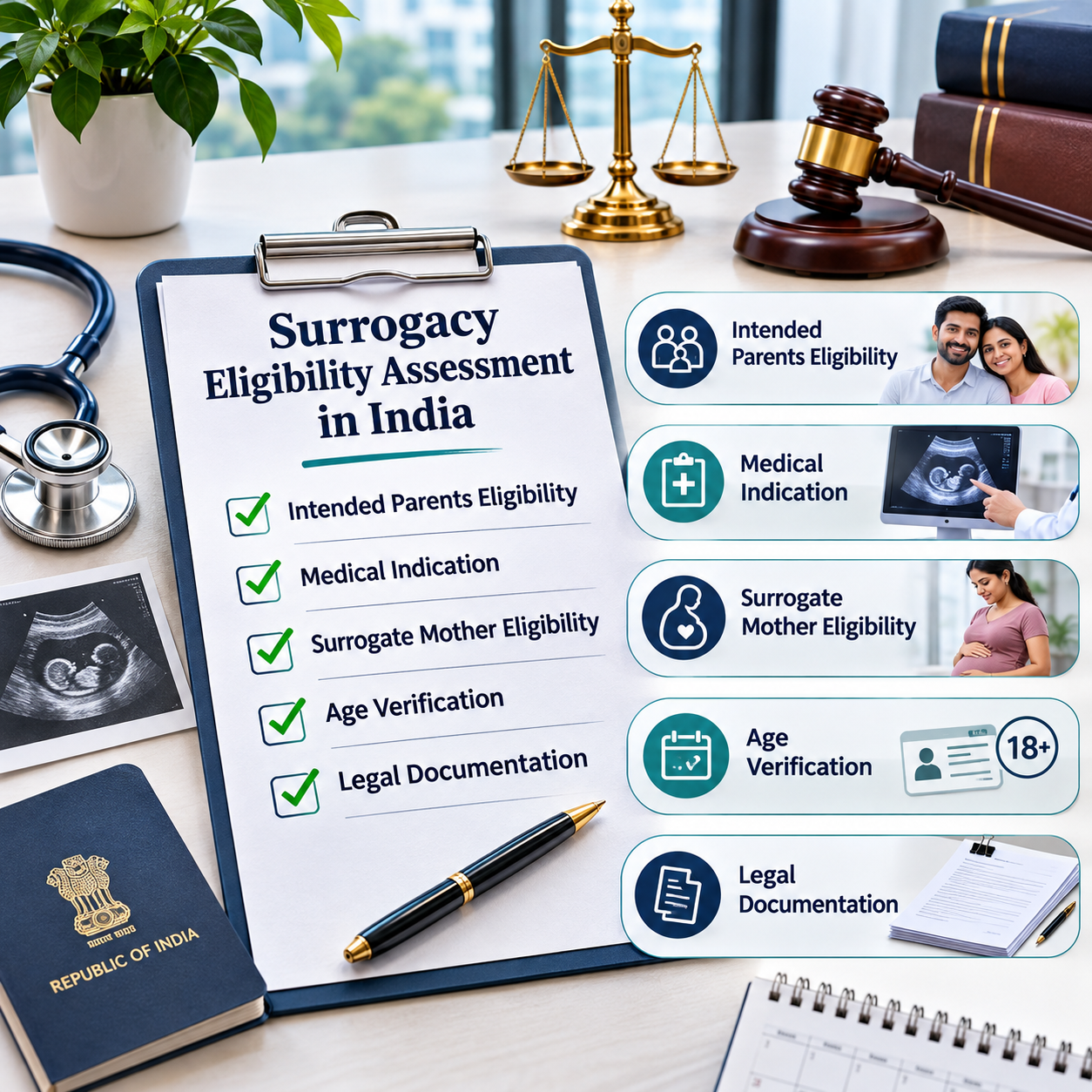
1. When Patients Need Surrogacy Eligibility Assessment
The Act limits surrogacy to legally married Indian couples and to Indian widows or divorcees aged 35 to 45. It also sets age limits for couples (the wife may not be over 50 and the husband not over 55) and, generally, requires that there is no surviving child. Refer a patient when age is borderline, when the couple already has a child, or when the patient is unmarried, in a live-in relationship or a single man, since the Act does not cover those groups.
Age cases need particular care. In October 2025 the Supreme Court held that the age limits do not apply to couples who froze embryos before the Act took effect on 25 January 2022. Whether a couple qualifies for that relief depends on documents, which is a legal question.
2. When Medical Indications for Surrogacy Need Legal Review
Surrogacy is available only where a District Medical Board certifies a medical indication. The 2024 Amendment Rules (notified 21 February 2024) allow one donor gamete where the Board certifies that the husband or wife has a medical condition requiring it. The child must still have at least one gamete from the intending couple, so a couple unable to provide any gamete is not covered. A single woman must use her own eggs with donor sperm. Refer whenever donor gametes are in play or the medical picture does not fit neatly into these rules.
3. When Intended Parents Need Legal Documentation
The process involves more than medical records. Intending parents need the surrogacy agreement and consent papers in the prescribed form, a court order on parentage and custody of the child, and proof of insurance for the surrogate. A lawyer can check that each document is complete and consistent before it reaches the clinic file.
4. When Surrogate Mother Eligibility Must Be Verified
The surrogate must be an ever-married woman with a child of her own, aged 25 to 35 on the day of implantation. She can act as a surrogate only once in her lifetime, cannot use her own gametes and needs a certificate of medical and psychological fitness. Refer when she has been a surrogate before, her age is close to a limit, or her paperwork does not match what the clinic was told. Payment beyond prescribed expenses and insurance is prohibited.
5. When Legal Certificates and Approvals Are Required
The Appropriate Authority issues a certificate of essentiality and eligibility certificates for the intending couple or woman and the surrogate. Treatment should follow these, not precede them. A lawyer can help prepare applications and, if one is refused or delayed, advise on the options the Act and Rules provide.
6. When International or Cross-Border Legal Questions Arise
The Act is framed around Indian couples and Indian women. Patients who live abroad, hold another nationality, or have NRI or OCI status raise eligibility questions that should not be answered informally at the clinic. Refer these cases before any commitment is made, and check the current position with a qualified lawyer.
7. When IVF Clinics Need Legal and Regulatory Compliance Guidance
Clinics also have their own obligations. A surrogacy clinic must be registered under the Act, and an ART clinic under the ART (Regulation) Act, 2021. Consents, records, advertising and financial arrangements all carry legal risk. Contravention can lead to imprisonment of up to five years and a fine of up to ₹10 lakh, and commercial surrogacy offences carry up to ten years and ₹10 lakh. Clinic owners and administrators should seek IVF clinic legal compliance advice in Bangalore before problems arise, not after a notice.

Why Do IVF Clinics in Bangalore Need Surrogacy Legal Consultation?
Because surrogacy is regulated by central law and administered locally, a Bengaluru clinic answers to the Karnataka State Appropriate Authority for its registration and certificates. There is no separate Bangalore or Karnataka surrogacy statute that we are aware of, so the practical risk lies in applying the national rules correctly. Legal consultation helps in six ways:
- Regulatory compliance: confirming registration under both Acts and tracking renewals.
- Documentation accuracy: catching expired, missing or inconsistent certificates before treatment.
- Legal eligibility: checking age, marital status and child history against the statute.
- Coordination: giving doctors, embryologists and administrators one clear checklist.
- Risk prevention: reducing the chance of notices, penalties or action by the medical council.
- Patient awareness: helping patients understand what is permitted before they commit emotionally and financially.
What Does the Surrogacy (Regulation) Act, 2021 Require?
The Act, read with the Surrogacy (Regulation) Rules, 2022 and the 2024 Amendment Rules, sets the conditions below. These are the Surrogacy Act 2021 legal requirements most relevant to a clinic.
- Intending couples: legally married Indian couples with a medical indication, within the age limits, and generally with no surviving child.
- Intending women: Indian widows or divorcees aged 35 to 45 with a medical indication, using their own eggs and donor sperm.
- Medical indication: a District Medical Board certificate that gestational surrogacy is needed.
- Surrogate mother: an ever-married woman with a child of her own, aged 25 to 35, acting once only, using no gametes of her own, with a fitness certificate.
- Certificates: a certificate of essentiality (including a court order on parentage and custody and 36-month insurance for the surrogate) and eligibility certificates, all from the Appropriate Authority.
- Altruistic only: no payment beyond prescribed medical expenses and insurance.
- Clinic registration: surrogacy clinics must be registered, with certificates valid for three years. ART clinics are registered separately under the ART Act for five years.
Check rule-level details, such as embryo transfer limits and the forms to use, against the current Rules, since these have been amended before and may change again.
How a Surrogacy Lawyer Supports IVF Specialists in Bengaluru
A surrogacy lawyer for fertility clinics can contribute at several points in the patient journey:
- Documentation review: checking agreements, consents, insurance proof and certificates for completeness.
- Eligibility guidance: explaining how the statute applies to a particular couple, woman or surrogate.
- Regulatory compliance: reviewing clinic registration, record-keeping and advertising practices.
- Legal clarification: answering questions on the Act, Rules and amendments so the clinic does not rely on outdated summaries.
- Coordination: working with the doctor, the patient and the clinic’s administrators to keep the file moving.
- Legal procedures: assisting with applications to the Appropriate Authority and, where needed, court proceedings.
Common Legal Mistakes IVF Doctors Should Avoid
Proceeding without verifying eligibility. Accepting a patient’s description of their age, marriage or children without documents.
- Incomplete documentation. A missing insurance record or unsigned consent can undermine an otherwise sound case.
- Misunderstanding the requirements. Relying on pre-2024 information about donor gametes, or on summaries that still describe earlier versions of the Bill.
- Ignoring regulatory approvals. Starting treatment while a certificate or clinic registration is pending or has lapsed.
- Wrong assumptions about commercial surrogacy. Treating payments, intermediaries or advertising as acceptable because the surrogate is willing.
- Not seeking guidance. Waiting until a notice or dispute arrives before involving a lawyer.
How to Choose the Right Surrogacy Lawyer in Bangalore
If you are searching for the best surrogacy lawyer in Bangalore, look for substance rather than slogans. Useful questions include:
- Does the lawyer work regularly in Indian surrogacy and ART law?
- Can they explain the Surrogacy Act 2021 and the ART Act, and the differences between them?
- Have they supported IVF clinics, not only individual patients?
- Do they communicate clearly with doctors and administrators who are not lawyers?
- Do they give ethical, qualified advice rather than guarantees of outcome?
Verify any claim of experience yourself, for example by asking for the lawyer’s enrolment details and a clear description of the services offered.
Why Early Legal Consultation Matters for IVF Doctors
The Act requires certificates before treatment, so mistakes found late are often costly or impossible to fix. An early consultation can reveal that a patient does not qualify, that a certificate is missing, or that a donor-gamete case needs a Board certificate. Knowing this at the first visit protects the patient from wasted time and expense, and protects the clinic from acting without authority.


Frequently Asked Questions (FAQs)
1. When should an IVF doctor refer a patient to a surrogacy lawyer?
Before any surrogacy procedure, and whenever eligibility, medical indication, donor gametes, certificates or the patient’s nationality are unclear. Early referral avoids treatment without the required approvals.
2. Why do IVF clinics in Bangalore need surrogacy legal consultation?
Bangalore clinics must follow the Surrogacy Act, 2021 and the ART Act, 2021, and are registered through the Karnataka State Appropriate Authority. Legal consultation helps them keep registrations, consents and certificates in order.
3. What are the legal requirements for surrogacy in India?
Only altruistic surrogacy for eligible Indian couples and widowed or divorced women is allowed. It needs a District Medical Board medical indication, eligibility and essentiality certificates, surrogate eligibility, prescribed consent, 36-month insurance for the surrogate and a registered clinic.
4. Can an IVF doctor independently determine surrogacy eligibility?
A doctor can assess the medical side, but statutory eligibility is decided through the District Medical Board and the Appropriate Authority, which issue the certificates. A doctor’s own view does not replace them.
5. What documents are required for surrogacy in India?
Key documents include the certificate of essentiality, the medical indication certificate, eligibility certificates for the intending parents and the surrogate, a court order on parentage and custody, insurance proof, and the consent and agreement in the prescribed form.
Conclusion
Knowing when to refer is part of good clinical practice. A timely doctor referral to a surrogacy lawyer in Bengaluru can confirm eligibility, check certificates, tidy documentation and keep the clinic on the right side of the Surrogacy Act, 2021 and the ART Act.
M&D Surrogacy Law provides legal services on surrogacy, assisted reproductive technology and fertility law in India. If you are an IVF specialist, clinic owner or intending parent in Bangalore, Bengaluru or elsewhere in Karnataka who needs legal guidance on a surrogacy matter, you can contact the firm to discuss your situation before treatment begins.
Get Expert Legal Help Today
Need legal guidance regarding frozen embryos, IVF consent agreements, surrogacy, fertility law, or reproductive rights?
Contact M&D Surrogacy Law Firm, Chennai, for a confidential consultation.
Our Chennai-based team specialises in Surrogacy Law, IVF & Fertility Law, ART Act Compliance, and Reproductive Rights Legal Consultation.