
Common Legal Mistakes Fertility Clinics Make and How to Avoid Them
Common Legal Mistakes Fertility Clinics Make and How to Avoid Them
Running an IVF centre in India is no longer only a medical and business challenge. Since the Assisted Reproductive
Technology (Regulation) Act, 2021 (the “ART Act”) came into force, every clinic and bank answers to a statutory regime
covering registration, consent, record-keeping and inspection. The legal mistakes fertility clinics make are rarely dramatic.
They are usually small gaps: a consent form with blank fields, a renewal filed late, an embryo discarded without a paper
trail. Under the Act, even small gaps can lead to suspension of registration, penalties and, in serious cases, criminal liability.
This guide walks through nine common errors, explains the rule behind each in plain language, and sets out practical fixes.
It also covers recent developments and ends with a checklist you can adapt. It is general information, not legal advice for
any particular clinic.
Which Laws Govern Fertility Clinics in India?
Four layers of law matter to most clinics.
The ART Act, 2021 (Act No. 42 of 2021). It regulates ART clinics and ART banks: registration, duties, donor rules and
offences. You can read the Act on India Code.
The ART (Regulation) Rules, 2022, as amended. The Rules set clinic levels, staffing, fees and the consent and
record forms. They were notified on 7 June 2022 and have been amended since, most recently by the ART (Regulation)
Amendment Rules, 2026. The National ART & Surrogacy Portal lists the current notifications.
The Surrogacy (Regulation) Act, 2021 and its Rules. These apply when a clinic also performs surrogacy
procedures. Our guide to the legal requirements for surrogacy in India covers that side.
Other laws. Section 45 of the ART Act says it operates in addition to other laws, including the Pre-conception and Pre
natal Diagnostic Techniques (Prohibition of Sex Selection) Act, 1994 and the Clinical Establishments (Registration and
Regulation) Act, 2010.
Appropriate authorities grant, suspend or cancel registration, and the National and State Boards supervise standards. For a
general overview of these bodies, see our explainer on the ART Act for IVF clinics in India.
The Legal Mistakes Fertility Clinics Make Most Often (and How to Fix Them)
The nine mistakes below come straight from the duties the Act and Rules place on clinics. Each section states the rule, the
typical error and a practical fix.
1. Operating Without Valid Registration or Missing Renewal Deadlines
Section 15(1) of the ART Act bars anyone from establishing a clinic or bank for ART unless it is duly registered. Registration
is valid for five years (section 16(6)) and must be renewed (section 17). The certificate must be displayed at a conspicuous
place (section 16(7)).
The 2026 amendment added a detailed renewal process. Under new Rule 8A, as published in the Gazette, a clinic applies on
the National Registry portal sixty days before expiry. The renewal fee is ₹25,000 for a Level 1 clinic and ₹1 lakh for a Level 2
clinic. If the application is late, the higher initial-registration fees apply.
The mistake: treating renewal as a back-office task, filing late, or letting the displayed certificate expire.
The fix: diarise expiry dates with reminders at 120 and 90 days, file at least sixty days early, and keep acknowledgments. If
registration is rejected, suspended or cancelled, the clinic can appeal within thirty days under section 19.
2. Offering Procedures Beyond the Registered Level, or Running Short on Staff
Rule 3 creates two levels. A Level 1 clinic carries out intrauterine insemination only. A Level 2 clinic may do surgical retrieval
of gametes, handle oocytes outside the body, fertilise, transfer embryos and store gametes or embryos. The Schedule to the
Rules requires a Level 2 clinic to have at least one gynaecologist, one anaesthetist, one embryologist and one counsellor,
with prescribed qualifications. It also lists minimum equipment, including at least two incubators.
The mistake: a Level 1 clinic drifting into IVF steps, an embryologist who does not meet the listed qualifications, or a
counsellor who exists only on paper.
The fix: map every service to your registered level, keep a staff register with qualification certificates, and re-check after
every hire or resignation. Remember that registered clinics can be inspected without notice under Rule 18.
3. Using Generic, Incomplete or Outdated Consent Forms
Section 22(1)(a) says a clinic shall not perform any treatment or procedure without the written informed consent of all
parties seeking ART. Rule 13(1)(f) lists the forms a clinic must maintain: Form 6 (couple or woman), Forms 7 and 8
(insemination), Form 9 (freezing embryos), Form 10 (freezing gametes), Form 11 (minors), Form 12 (oocyte retrieval) and
Form 13 (oocyte donor). Each carries an endorsement by the clinic, a witness and the doctor.
The mistake: one all-purpose form, blank fields (for example, the number of years for storage in Forms 9 and 10), missing
spouse or witness signatures, or no evidence that the explanation actually happened.
The fix: use the notified forms as your base, complete every field, and add a plain-language explanation in a language the
patient understands. Consent can be withdrawn at any time before embryos or gametes are transferred (section 22(4)), so
file withdrawals with the same care as consents.
4. Mishandling Frozen Embryos and Gametes
A clinic may not cryo-preserve embryos or gametes without written instructions from all parties on what happens in case of
death or incapacity (section 22(2)). Stored gametes or embryos may be kept for no more than ten years, after which they
must perish or, with consent, go to a registered research organisation (section 28(2)). Rule 13(1)(b) allows longer storage
for onco-fertility patients with the National Board’s permission. Unused gametes and embryos must be kept for the same
recipient and not used for anyone else (Rule 13(1)(a)).
The mistake: discarding embryos without a documented trail, keeping them past ten years without permission, or having
no instructions on file for death or incapacity.
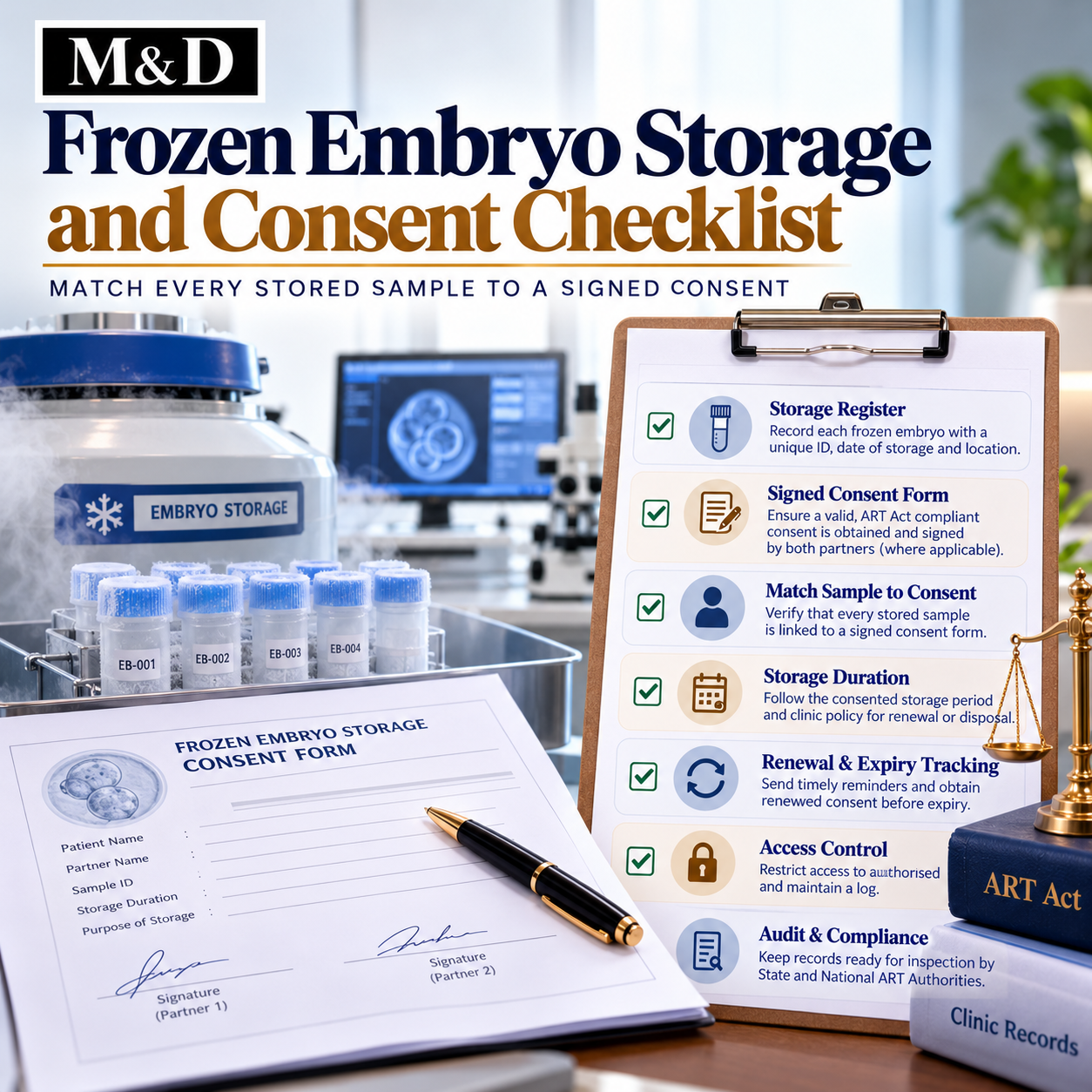
The fix: keep a storage register showing tank, date, consent form and review date. The notified Forms 9 and 10 treat
twelve months of no contact, or no reply within ninety days of a request, as abandonment. Even so, record every attempt to
reach the patient by post, email and phone before acting. Our posts on whether an ART clinic can destroy frozen embryos,
who owns frozen eggs and sperm and use of embryos after an intended parent’s death explore these disputes.
5. Overlooking Age and Eligibility Limits
Section 21(g) tells clinics to provide ART only to a woman above 21 and below 50 and a man above 21 and below 55.
Section 21(a) also requires clinics to confirm that the commissioning couple, the woman and the donors are eligible. The Act
defines a “commissioning couple” as an infertile married couple, so check the current Rules for any later widening of
categories.
Courts have also examined age limits in the surrogacy context. In Arun Muthuvel v. Union of India (2025 INSC 1209, decided
9 October 2025), the Supreme Court held that the age limit for intending couples in section 4(iii)(c)(I) of the Surrogacy
(Regulation) Act does not apply retrospectively to couples who had frozen embryos before the Act came into force on 25
January 2022. You can read the judgment on Indian Kanoon. That ruling concerns the Surrogacy Act, so do not assume it
automatically changes a clinic’s duty under section 21(g).
The mistake: relying on a stated age without ID, or deciding borderline cases at the front desk.
The fix: verify age from government ID, record the date embryos were created and frozen, and send borderline cases for
legal review.
6. Careless Donor Sourcing and Documentation
Clinics must obtain donor gametes from banks (section 21(b)), and only a registered bank may screen donors and store
semen (section 27(1)). The Act sets donor age bands: semen donors 21 to 55 and oocyte donors 23 to 35 (section 27(2)). A
single donor’s gametes may not go to more than one commissioning couple (section 27(3)), and an oocyte donor may
donate only once, with no more than seven oocytes retrieved (section 27(4)). Donors must be tested for HIV, hepatitis B,
hepatitis C and syphilis (Rule 10).
The commissioning couple or woman must buy twelve months of health insurance for the oocyte donor and the couple signs
an affidavit (section 22(1)(b) and Rule 12). Using intermediaries to obtain or purchase donors is prohibited (section 33(1)
(g)). A donor relinquishes all parental rights (section 31(2)), a point we explain in can a sperm donor claim rights over a
child.
The mistake: accepting donors from agents, skipping the check for earlier donations, or filing incomplete insurance and
affidavit papers.
The fix: source only from registered banks, match donor IDs against Forms 14, 14A and 14B, and keep the policy copy and
affidavit in the patient file
7. Weak Records, Confidentiality and Registry Reporting
Section 23 requires detailed records of donor oocytes, sperm and embryos, used or unused. Clinics must submit information
online to the National Registry within one month of receiving it, keep records for at least ten years and then transfer them to
the Registry’s central database. On closure, records must go to the Registry immediately. If criminal or other proceedings
begin, records must be preserved until final disposal. Section 21(h) requires a discharge certificate, and section 21(j)
requires periodic reporting.
Confidentiality is a separate duty under section 21(e). Information about the commissioning couple, woman and donor may
be disclosed only to the Registry database, in a medical emergency at the couple’s request, or under a court order.
The mistake: gaps in paper registers, late Registry uploads, staff discussing patients with relatives, or using patient stories
in marketing without written consent.
The fix: assign one owner for Registry submissions, set a monthly reporting calendar, restrict file access, and require
signed confidentiality undertakings from staff.
8. Weak Counselling and Prohibited Practices
Section 21(c) requires professional counselling on the implications and chances of success of procedures. Clinics must also
explain advantages, disadvantages, cost, side effects and the risk of multiple pregnancy, and make patients aware of the
rights of a child born through ART (section 21(d)). Section 24(b) caps transfers at three oocytes or embryos per treatment
cycle. A clinic may not mix semen from two individuals or split embryos to increase their number (section 24(d) and (e)).
Sex selection is a red line. Section 26 bars offering a child of a pre-determined sex, and Rule 13(1)(e) bars pre-implantation
genetic testing for non-medical sex selection or trait preferences. Under section 32, advertising sex-selective ART is
punishable with five to ten years’ imprisonment, or a fine of ₹10 lakh to ₹25 lakh, or both.
The mistake: transferring more than three embryos, using language on a website or social post that hints at sex choice, or
promising results.
The fix: build hard stops into your protocols, review every web page and social post for sex-selection language, and
document counselling in the file. The notified consent forms themselves say no guarantee of pregnancy or live birth can be
given, so your marketing should not say otherwise.
9. Treating Compliance as Paperwork Instead of Governance
Every clinic and bank must maintain a grievance cell (section 21(f), Rule 11 and Form 5). The Boards and Registry can
inspect premises and call for documents (section 20) and, where they suspect an offence, enter, search and seize records
(section 40). Where a clinic commits an offence, its executive head is deemed guilty unless he or she proves the offence
happened without knowledge or that all due diligence was exercised (section 37).
Section 33(1) also prohibits abandoning, disowning or exploiting children born through ART, selling embryos or gametes,
running an agency to trade in them, importing them and exploiting couples or donors. Section 29 restricts the sale, transfer
or use of gametes and embryos within or outside India, except for personal use with the National Board’s permission.
The mistake: a grievance cell that exists only on a notice board, no named compliance lead, and no rehearsal for an
unannounced inspection.
The fix: appoint a compliance officer, run quarterly mock inspections, keep a complaint log, and have a lawyer review
contracts with donor agents, egg-retrieval partners and international patients. This is the most reliable way to avoid the
legal mistakes fertility clinics make under pressure.

Recent Developments Clinics Should Track
Several developments affect how clinics avoid the legal mistakes fertility clinics make:
Renewal rules (June 2026). The Amendment Rules notified on 17 June 2026 inserted rules 7A and 8A covering fee
deposit and renewal. Check the official Gazette copy before relying on any summary.
Review of both Acts. The National ART & Surrogacy Portal lists a notice dated 11 March 2026 on a comprehensive
review of the ART Act and the Surrogacy Act. Watch for proposals that change consent, donor or registration rules.
Trafficking concerns. In June 2026 the Supreme Court, hearing the Pinki v. State of Uttar Pradesh compliance matter,
was told by the amicus curiae that no standard operating procedure addresses child trafficking through ART and
surrogacy centres, and sought the Union’s response. The case was listed for a further hearing on 19 August 2026. Check
the current status. Clinics should be able to show lawful provenance for gametes, embryos and outcomes.
Surrogacy donor gametes. The Surrogacy (Regulation) Amendment Rules, 2024 allow one donor gamete where a
District Medical Board certifies medical necessity. Surrogacy clinics should confirm the current rule text.
A Practical Compliance Checklist for Clinic Owners
Use this as a starting point and adapt it to your registration level.
1. Confirm registration level, expiry date and that the certificate is displayed.
2. Match services to the registered level and check staff qualifications.
3. Audit ten recent patient files for complete, signed, witnessed consent forms.
4. Reconcile the frozen embryo and gamete register against consents and storage dates.
5. Verify donor source, age, testing, insurance and affidavit for each donor case.
6. Check Registry submissions and the ten-year retention plan.
7. Review the website, social media and brochures for sex-selection or guarantee language.
8. Test the grievance cell and name a compliance officer.
9. Calendar the next Rules or Gazette review each quarter.
When to Involve a Fertility Lawyer
Bring in counsel before a problem becomes a complaint. Typical moments include drafting or updating consent and storage
agreements, handling abandoned embryos, responding to an inspection or show-cause notice, reviewing donor-agent
contracts, and advising on cross-border patients. Our team’s IVF and fertility law service supports clinics with compliance
reviews and documentation.


Surrogacy for foreign nationals is heavily regulated.
NRIs may face:
- Citizenship issues
- Immigration requirements
- Additional compliance procedures
Recommendation
Obtain legal advice before proceeding.
Conclusion
The legal mistakes fertility clinics make usually trace back to five habits: lapsed registration, weak consent, poor storage
records, careless donor paperwork and treating compliance as someone else’s job. Each can be fixed with clear ownership, a
calendar and a file audit. The central answer to the question in this guide’s title is simple: know the ART Act’s duties,
document every consent and decision, and review your practice whenever the Rules change.
If you run or advise an ART clinic and want a structured review, you can book a consultation with M&D Surrogacy Law Firm.
This article is general information and does not guarantee any legal outcome.
Frequently Asked Questions (FAQs)
Is registration mandatory for fertility clinics in India?
Yes. Section 15(1) of the ART Act says no person may establish a clinic or bank for ART unless it is duly registered.
Registration is valid for five years and can be renewed.
How do I renew my ART clinic registration?
Under Rule 8A, inserted by the 2026 amendment, the clinic applies on the National Registry portal sixty days before expiry.
The Gazette text lists a renewal fee of ₹25,000 for Level 1 clinics and ₹1 lakh for Level 2 clinics. Late applications pay the
initial-registration fee. Confirm the details against the official notification.
What consent forms must an IVF clinic keep?
Section 22(1)(a) requires written informed consent of all parties. Rule 13(1)(f) lists Forms 6 to 13, covering treatment,
insemination, freezing of embryos and gametes, oocyte retrieval and oocyte donation. ART banks keep Form 15 for sperm
donors.
How long can a clinic store frozen embryos and gametes?
Section 28(2) allows storage for no more than ten years. Afterwards the material must perish or, with consent, go to a
registered research organisation. Rule 13(1)(b) permits longer storage for onco-fertility patients with the National Board’s
permission
Can a fertility clinic offer sex selection?
No. Section 26 prohibits offering a child of a pre-determined sex. Advertising sex-selective ART is punishable under section 32
with five to ten years’ imprisonment, or a fine of ₹10 lakh to ₹25 lakh, or both.
What are the penalties for the legal mistakes fertility clinics make?
it depends on the breach. Registration can be suspended or cancelled after a hearing (section 18). Prohibited acts under
section 33(1) carry fines and, for repeat offences, imprisonment. The executive head can be deemed guilty unless due
diligence is shown (section 37)
Can a sperm or egg donor claim parental rights?
Under section 31(2), a donor relinquishes all parental rights over children born from his or her gamete. Individual disputes
can still raise complicated questions, so seek legal advice.
Get Expert Legal Help Today
Need legal guidance regarding frozen embryos, IVF consent agreements, surrogacy, fertility law, or reproductive rights?
Contact M&D Surrogacy Law Firm, Chennai, for a confidential consultation.
Our Chennai-based team specialises in Surrogacy Law, IVF & Fertility Law, ART Act Compliance, and Reproductive Rights Legal Consultation.